Fifty, Solo, and Absolutely Fearless: What Costa Rica Taught Me About Traveling on My Own Terms
I booked the ticket at 11:47 p.m. on a Tuesday, in my pajamas, with a half-empty glass of Malbec on the nightstand. My cursor hovered over the "confirm purchase" button for probably four full minutes. Solo. Costa Rica. Fourteen days. Just me.
I was 50 years old, freshly untethered from a long-term relationship, and deeply tired of waiting for the "right time" or the "right person" to see the world with. So I clicked.
What followed was one of the most transformative experiences of my adult life — and also one of the most surprisingly manageable. Here's everything I wish someone had told me before I went.
The Fear Is Real. So Is the Fact That It Shrinks Fast.
Let's be honest about the anxiety, because I know you're feeling it too. Before I left, I had a running list of worries that I'd mentally titled "Reasons This Is Probably Stupid." Language barrier. Getting lost. Eating alone at restaurants. Being that solo woman at a table for one, staring at her phone while couples laughed around her. What if I got hurt? What if I couldn't keep up physically? What if I was just... too old for this kind of trip?
Here's what nobody tells you: Costa Rica has been quietly perfecting the art of welcoming independent travelers for decades. It's one of the most tourism-literate countries in the Western Hemisphere. Signage in tourist areas is bilingual. Locals in hospitality — and honestly, just locals in general — are remarkably patient with Spanish-challenged gringas like me. My high school Spanish was embarrassingly rusty, but a combination of Google Translate, enthusiastic hand gestures, and the universal language of genuine smiling got me through every single situation.
The fear didn't disappear on day one. But by day three, it had quietly folded itself up and moved to the back of the drawer.
Zip-Lining in Monteverde (Yes, at 50. Yes, You Should.)
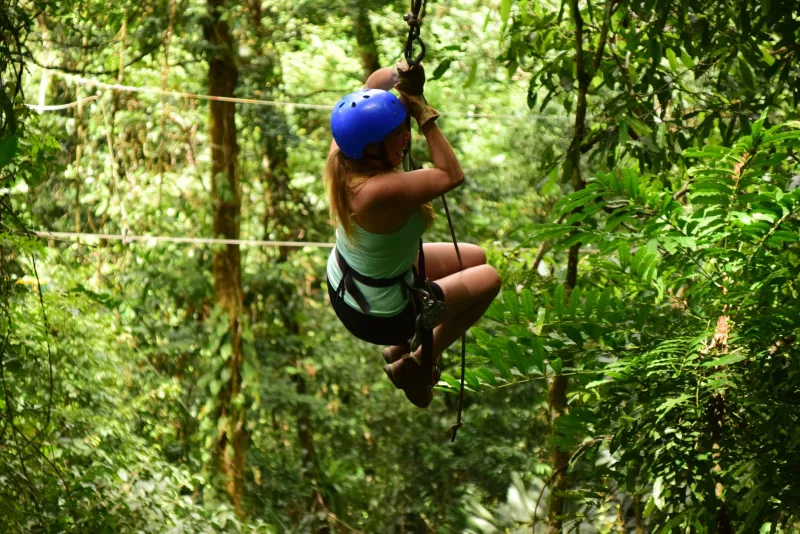
I almost skipped the zip line. I told myself it was because I'd "seen enough zip lines" — which was a lie, because I had never been on one. The real reason was that I pictured myself as the oldest person on the platform, struggling with the harness while twenty-somethings in Lululemon looked on sympathetically.
The reality? The guides at the Selvatura Park zip-line course in Monteverde have seen every age, every fitness level, and every flavor of nervous. My guide, a compact and cheerful man named Randall, adjusted my harness with calm efficiency and then told me, completely unprompted, that his grandmother had done the course for her 65th birthday. Whether or not that story was 100% true, it worked.
Flying over the Monteverde cloud forest canopy — the mist curling up through the treetops, the howler monkeys genuinely howling in the distance — was one of those moments where your brain just stops narrating and you become pure sensation. I screamed. I laughed. I did six more lines after that.
Physical fitness caveat: You don't need to be an athlete. You need to be able to walk moderate distances and handle some uneven terrain. Most reputable tour operators are transparent about physical requirements. Ask questions before you book. There is no shame in choosing the scenic gondola over the zip line — the cloud forest is stunning from every angle.
Lunch at the Mercado Central: The Meal That Changed Everything
San José gets a bad reputation in travel circles. Travelers rush through it on their way to beaches and rainforests, treating it like an inconvenient layover rather than a destination. That is a mistake.
On my second day, I wandered into the Mercado Central — a covered market in the heart of downtown that has been feeding San José since 1880. It smells like roasting coffee, ripe plantains, and something frying in good oil. I found a tiny lunch counter near the back and sat down next to two women who appeared to be in their mid-fifties, sharing a casado — the classic Costa Rican plate of rice, beans, salad, and protein — and talking with the easy rhythm of old friends.
Through a halting combination of Spanish and English, we managed a real conversation. They were sisters. One was a schoolteacher; the other ran a small bakery. They had opinions about the best beaches (Playa Sámara, they said firmly, not the ones the tourists go to). They thought it was wonderful that I had come alone. "Las mujeres solas son las más valientes," one of them said. Solo women are the bravest.
I think about that lunch a lot.
The Sea Turtles of Tortuguero Will Undo You
Nothing prepared me for Tortuguero. The town itself is accessible only by boat or small plane — no roads in, which immediately filters out a certain kind of traveler and preserves something genuinely wild about the place. I took a water taxi from the dock near Cariari, which was an adventure in its own right: two hours through winding canals lined with jungle so dense and green it looks almost artificial.
I joined a guided night tour to watch leatherback sea turtles come ashore to nest. The rules are strict — no white flashlights, no phones, stay behind the guide, absolute silence on the beach. We stood in the dark for what felt like a long time before she appeared: an ancient, enormous creature hauling herself up the sand with a determination that felt almost sacred.
I cried. I'm not embarrassed about it. There is something about witnessing a 500-pound animal who has been navigating the same ocean for longer than humans have kept records, doing the same thing her ancestors did millions of years ago, that puts your own midlife anxieties into generous perspective.
Practical note: Book your Tortuguero night tour through a certified guide and lodge well in advance. The nesting season runs from March through October, with peak activity in July and August.
The Pura Vida Thing Is Not a Tourist Slogan
You will hear pura vida constantly in Costa Rica. It means, literally, "pure life," but it functions as a greeting, a farewell, a response to "how are you," and a general philosophy of radical contentment. I assumed it was the kind of phrase that gets printed on refrigerator magnets and loses all meaning in translation.
I was wrong. The philosophy is real, and it's contagious in the best way. Costa Ricans have a measurably high life satisfaction — the country consistently ranks among the happiest in the world. That energy is tangible. It shows up in the unhurried pace of a conversation, in the way a stranger will spend ten minutes drawing you a map when you're lost, in the communal pride in the country's extraordinary natural beauty.
For a woman traveling alone at 50, that energy is a gift. Nobody made me feel like an oddity. Nobody asked where my husband was. The general cultural vibe was: you are here, you are welcome, enjoy the life.
What I Wish I'd Known Before I Went
- Safety is real, but so is common sense. Costa Rica is one of the safer countries in Central America, but petty theft exists, especially in San José. Use a money belt, don't flash expensive gear, and trust your gut in unfamiliar neighborhoods.
- Book a mix of accommodation. I loved my boutique eco-lodge in Monteverde and my small guesthouse in Tortuguero run by a local family. Both felt safe and genuinely welcoming to solo women.
- Eat at the sodas. These are small, family-run local restaurants. They are cheap, delicious, and a far better cultural experience than any tourist-facing restaurant. A casado at a soda will cost you around $5–8 and will be one of the best meals you eat.
- Solo dining is a non-issue. Bring a book if it makes you feel better, but you probably won't need it. You'll be too busy watching the world.
I came home from Costa Rica two weeks later with mud on my boots, a deep tan, and a quiet but unshakeable certainty that I was not, in fact, too old for any of this. I was, if anything, exactly the right age.
Pura vida, chicas. Book the ticket.